Choosing the Right AAC Device
Key considerations for choosing an AAC device that supports communication, independence, and language development.
5
MIN READ TIME
10/4/26
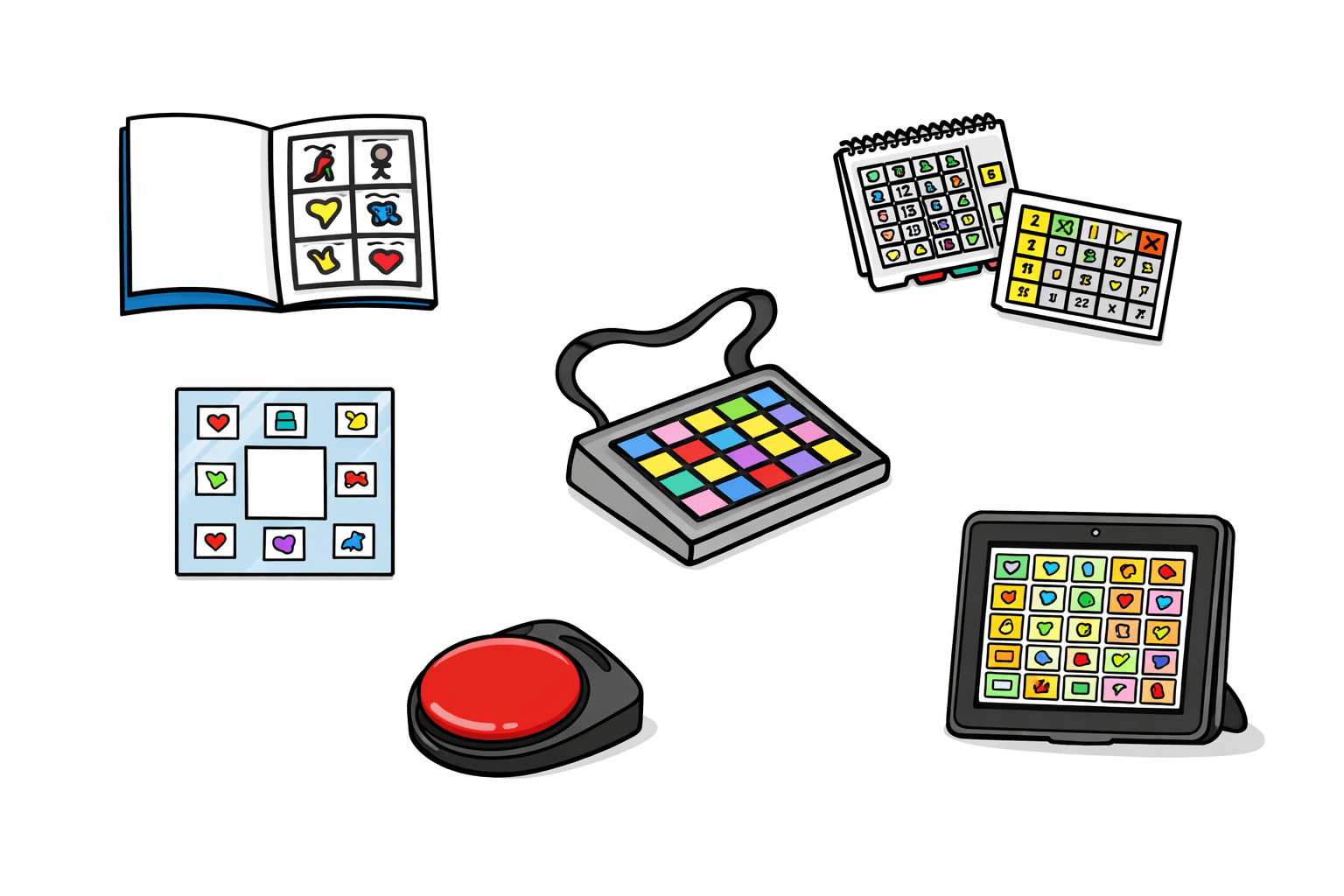
Choosing the Right AAC Device & What Actually Matters?
Choosing the right AAC system is not about selecting the most popular device or the latest technology.
It is about identifying the system that will best support the individual’s long-term communication, independence, and meaningful participation across environments.
Key considerations include, but are not limited to, the vocabulary system, layout stability and predictability, speaker volume, durability, access method, storage capacity, portability and size, long-term language development, and the integration of both high-tech and low-tech supports.
1. Vocabulary System
The most important feature of any AAC system is the language system inside it. We want a system that:
Provides access to core vocabulary (high-frequency words like go, stop, more, want, help)
Allows for growth over time
Keeps word locations consistent as vocabulary expands
Supports sentence building, not just single words
A device that only offers a small number of buttons or mostly nouns may look simple, but it can limit long-term language development. AAC should be able to grow with the communicator.
2. Stability and Predictability
Motor planning is powerful. Many robust AAC systems keep vocabulary in the same location, even as more words are added. This supports:
Faster access
Reduced cognitive load
Increased independence
Automaticity over time
Frequent layout changes or constantly moving buttons can make communication harder, not easier.
3. Speaker Volume
This is often overlooked. If a communicator cannot be heard in:
A classroom
The playground
Community settings
Noisy family environments
Then the system is not fully functional. A strong inbuilt speaker (or external speaker option) is essential for real-world communication.
4. Durability
AAC devices are used everywhere:
On the floor
Outside
In the car
At school
At therapy
They may be dropped. They may be bumped. They may be used enthusiastically. A durable, protective case or a dedicated rugged device can significantly reduce stress and risk of breakage. This is especially important for active children or busy environments.
5. Access Method
How does the individual physically access the device?
Consider:
Direct touch
Keyguards
Switch access
Eye gaze
Stylus
Mounting systems
The best AAC device is one the person can access reliably and independently.
6. Storage Capacity
Modern AAC devices are more than voice output tools. They often store:
Photos
Videos
Visual supports
Social stories
Personalised content
Adequate storage ensures the device can be customised meaningfully without running into limitations.
7. Portability and Size
Bigger screens offer more visual space. Smaller devices are lighter and easier to carry.
We must balance:
Visual clarity
Motor accuracy
Portability
Environmental demands
The right size depends on the individual.
8. Long-Term Language Development
The ultimate question is not: “Is this device easy right now?”. But rather, “Will this device support communication growth over the next 5–10 years?”. AAC is not a short-term solution. It is a communication system.
We choose tools that:
Presume competence
Offer robust vocabulary
Support autonomy
Promote participation across settings
9. High-Tech vs Low-Tech
Low-tech systems (such as laminated communication boards or printed core vocabulary pages) are valuable tools. They support modelling, accessibility, and quick access in a range of environments.
Importantly, low-tech should always be provided alongside high-tech AAC. Technology can fail. Devices can go flat, freeze, break, or be unavailable in certain settings. Communication, however, cannot stop. A low-tech backup ensures the individual always has a way to express themselves, regardless of battery life or technical issues.
Many individuals benefit from high-tech speech-generating devices because they:
Provide voice output
Increase social participation
Reduce reliance on others to interpret messages
Allow communication with unfamiliar communication partners
Support more complex language generation
High-tech systems often promote greater independence and broader participation, particularly in community and school settings.
The most effective approach is not choosing one over the other.
It is ensuring both are available, so communication remains consistent, reliable, and supported across all environments.
Final Thoughts
Choosing an AAC device is not about selecting the newest tablet or the simplest layout.
It is about ensuring the system is fit for purpose.
AAC must work in the real world. It must suit the individual’s communication needs, environments, motor access, cognitive profile, sensory profile, and long-term language development. A device that looks good on paper but cannot be heard in a classroom, carried independently, or accessed reliably is not truly functional.
When selecting AAC, we consider:
Access
Growth
Stability
Volume
Durability
Backup systems
Independence
Most importantly, we ensure the communicator has a system that allows them to express more than basic needs.
It is also important to note that AAC systems should be selected in collaboration with a qualified speech pathologist, following a comprehensive assessment and, where possible, structured trials across real-life environments. Recommendations should be based on individualised data, not brand preference, convenience, or cost alone.
AAC is not a last resort. It is a communication system.
When it is fit for purpose and selected thoughtfully, it supports autonomy, identity, and meaningful participation across the lifespan.

Speech Pathologist
Lucy McKay